
- How ECOWAS-trained Anambra youths are breaking fresh grounds in fish production business
By Obinna Odogwu
The management team of Elite Table Fish (Aguleri) Co-operative Society Ltd filed out of the conference room of the Fisheries and Aquaculture Business Development Agency (FABDA) in Awka, beaming with smiles.
The team had just signed a lucrative business deal with TeeMartins ICT Ltd for the deployment of its Taenprowiz Fish Production Business System and Technology, an innovative aquaculture model designed to support industrial-scale fish production.

The deal was their first major business breakthrough since the organisation was set up, following their graduation from a six-month training course funded by the Economic Community of West African States (ECOWAS).
The officers and members of the cooperative were among the 150 youths in Anambra State who were trained on Table Fish Production Business using the Taenprowiz System and Technology, a proven, scalable aquaculture production model supported by ECOWAS.
How it all started
In October 2023, the ECOWAS Commission granted the Fisheries and Aquaculture Value Chain Development Partnership Centre in the state the sum of $58,768 for the training of 150 youths in fish production business.
The then Commissioner for Economic Affairs and Agriculture in the Commission, Mrs. Massandjé Toure-Litse, explained that the training course was part of the implementation of the Commission’s regional strategy to support the employability of young people in the agro-sylvo-pastoral and fisheries sector.
She disclosed that 25 centres in the 15 ECOWAS member states were selected for various programmes, and that FABDA and Table Fish Production (Awka) Cooperative Society Ltd were jointly selected as one of the four centres in Nigeria to which the Commission had granted subsidies to train young people.
Toure-Litse said that the initiative was part of the Commission’s broader vision to move the regional political and economic union from ECOWAS of States to “ECOWAS of peoples: peace and prosperity for all” by 2050.
To achieve that target, she said that ECOWAS management, under the leadership of Dr. Omar Alieu Touray, adopted four strategic objectives that would run from 2022 to 2026, representing a four-year mandate.
The mandates, according to her, were designed to strengthen regional peace and security, deepen regional integration, promote good governance, and promote inclusive sustainable development to stimulate economic growth, create employment opportunities and promote food security in the ECOWAS region.
“The agro-sylvo-pastoral and fisheries sector is particularly important to this vision, and falls within the scope of Objective 4, offering considerable potential for creating sustainable jobs for men, women and young people, strengthening food security and promoting rural development”, she added.
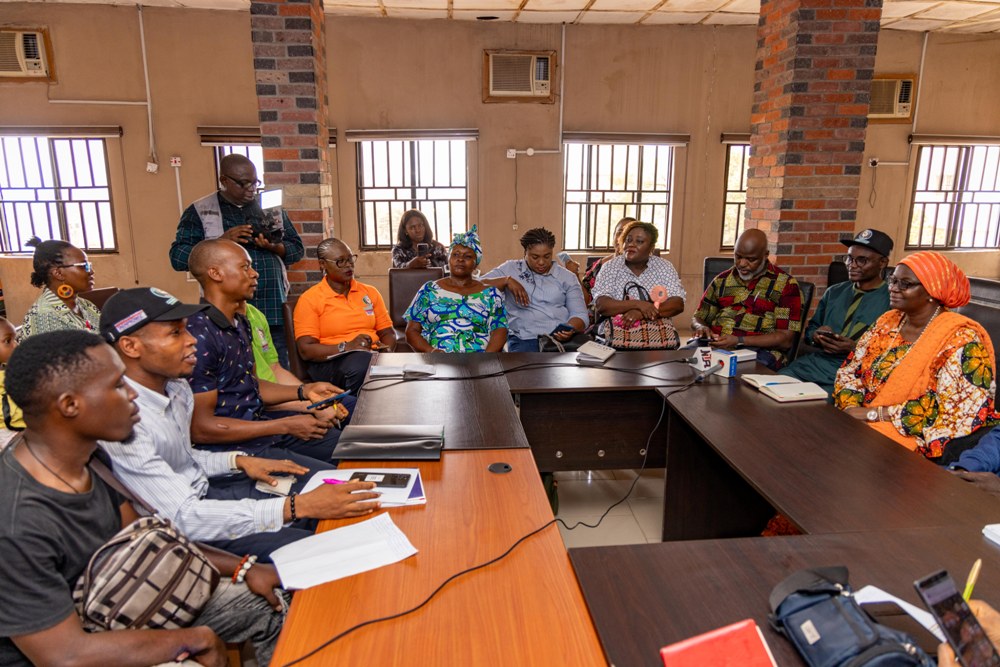
On October 23, 2023 the Managing Director/CEO of FABDA, Mr. Emeka Iloghalu, held a press conference in Awka to mark the commencement of the training course which took place at Anambra State Polytechnic, Mgbakwu in Awka North Local Government Area of the state.
He said that the training programme, which took place in a 2,650kg/month throughput farm, was basically to make the young people employable by arming them with the relevant skills which would enable them to earn decent income.
The trainees were divided into six business groups, and were each assigned four tanks to execute the table fish production business operations just as they were being taught.
The tanks, white in colour, were numbered from 01 to 24, coded WT01 to WT24 before they were assigned to each of the groups.
Business Group A was assigned WT01 to WT04. Business Group B got WT05 to WT08; just as Business Group C got from WT09 to WT12.
Others were: Business Group D – WT13 to WT16; Business Group E – WT17 to WT20; Business Group F – WT21 to WT24.
Accordingly, each of the groups was given some quantity of seed fish for their tanks to enable them to have practical experiences as the lessons were being delivered. They were given varying sizes of fingerlings as well.
The first stocking for Group A weighed 15.7g; 15.8g for Group B; 14.9g for Group C; 15.3g for Group D, 15.5g for Group E and 15.4g for Group F.
As a group, they carried out their assignments together, stocking, grading, feeding, recording, and taking care of other tasks till the fish reached targeted harvest weight.
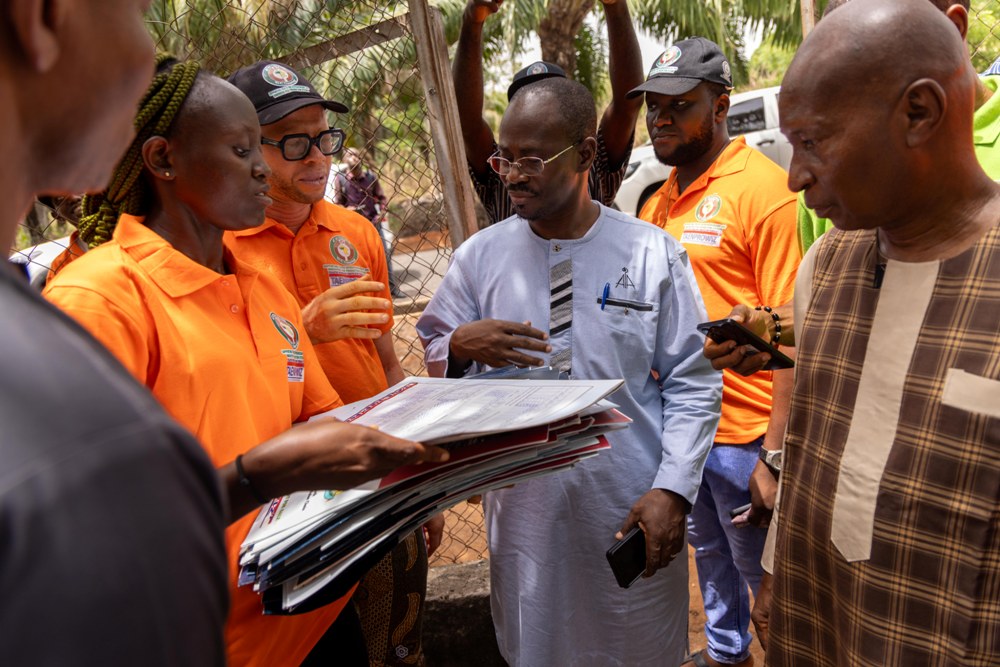
The trainees commended the ECOWAS Commission for the opportunity to participate in the all-important training course, saying that their expectations were fully met.
One of them, Ukamaka Ifejika, recalled that she had a wonderful experience during the training sessions, saying that she learned so many things.
“That was the best training course that I’ve ever been to”, she remarked, adding: “I didn’t know that to produce fish was as big as that.”
Another former trainee, Innocent Nwosu, pointed out that there was never a dull moment throughout the period of the course. “The training was fortified with information”, he added.
The FABDA MD, Iloghalu, who was also the coordinator of the partnership centre, said that the trainees were taken through five core skills that are essential in fish production, namely: stocking, feeding, grading, water parameter measurement, and harvest skills.
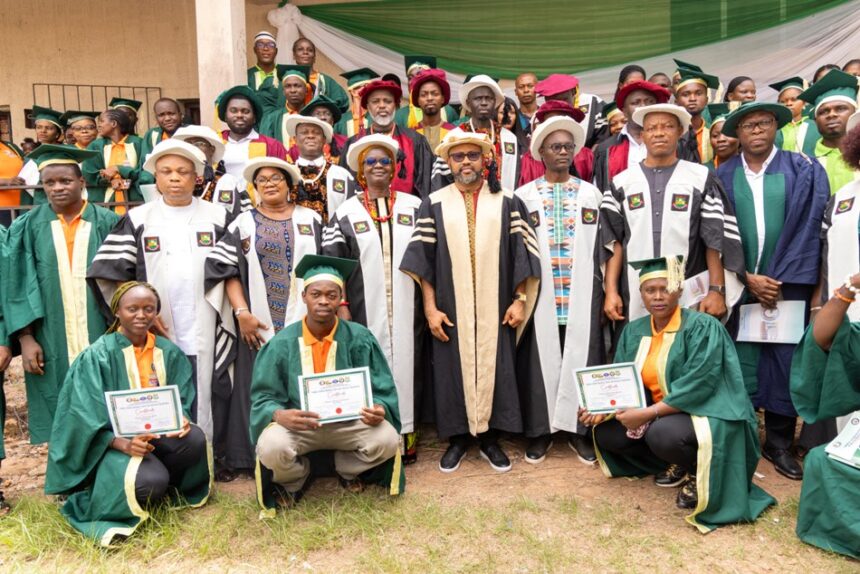
At the end of the six-month training course, a team from ECOWAS Commission led by Mrs. Massandjé Toure-Litse graced the graduation ceremony which also took place in the Mgbakwu polytechnic.
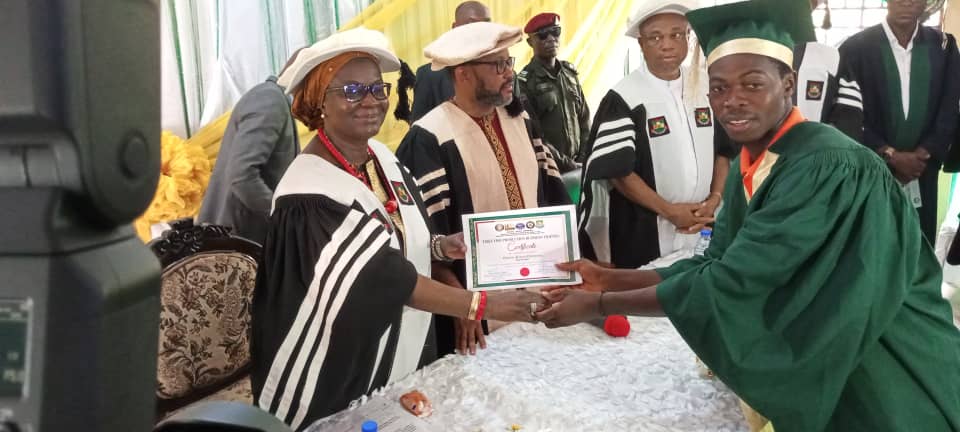
It was gathered that eight specialised fish business co-operatives were later formed to further the gains of the 2023/2024 cohort of the ECOWAS Youth Training on Taenprowiz Fish Production Business System and Technology.
The cooperatives are: Peculiar Table Fish (Aguleri) Co-operative Society Ltd, Dynamic Table Fish (Aguleri) Co-operative Society Ltd, Supreme Table Fish (Aguleri) Co-operative Society Ltd, and Elite Table Fish (Aguleri) Co-operative Society Ltd.
Others are: Excel Table Fish (Aguleri) Co-operative Society Ltd, Premier Table Fish (Aguleri) Co-operative Society Ltd, Ecowiz Seed Fish Production Co-operative Society Ltd, and Ecowiz Fish Products Trading Co-operative Society Ltd.
Post-graduation business activities
The activities of the trainees after their graduation suggest that the purpose of the course as designed by the ECOWAS Commission has so far been largely actualised.
Findings show that many of the young people who participated in the training course are already using the skills they gained to earn decent income. While some are running their own fish business, others are offering consultancy services.
On May 12, 2026, Elite Table Fish (Aguleri) Co-operative Society Ltd and TeeMartins ICT Limited signed a franchise agreement to enable the former to use the latter’s Taenprowiz technology for the purpose of industrial-scale fish production.
It was aimed at boosting fish production output, youth employment, and enhanced aquaculture output in the state.
The business partnership was facilitated by FABDA which also hosted the signing ceremony in its office in Awka, the Anambra State capital.
Elite Cooperative, by the agreement, is expected to transition from small scale fish farming to a more structured, industrial-scale production using the Taenprowiz technology which supports accuracy and high-precision business decision-making.
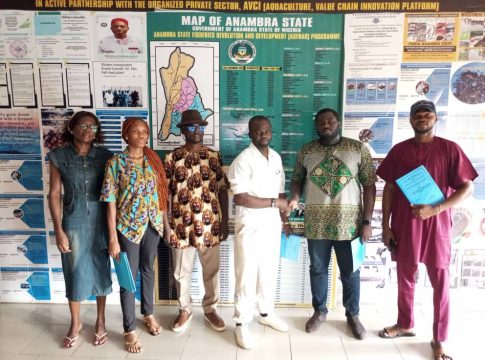
Its president, Mr. Chukwuma Onyekwe, said that his team was excited about the deal, especially considering that it was their first major business breakthrough post-ECOWAS training.
“It has been a challenging journey since we started, but we believe the system and technology will help us achieve our vision in commercial fish production”, he said.
Also speaking, the treasurer of the cooperative, Afoma Odili, disclosed that the group has not only started producing fish in large quantities, but was already making plans to move to a bigger facility in order to expand their business.
“We are currently making arrangements to move to the fish village at Adazi-Nnukwu to also continue our fish production business”, she revealed.
Odili, who is also the Chairperson of the Shareholders’ Committee, commended the ECOWAS Commission for the training programme, saying that the trainees found it very useful and helpful.
“It changed our view on fish business; because a lot of people in the fish business usually crash out because of a lot of issues with fish production”, she pointed out.
Asked about the cooperative’s business projections and expectations in the next five years, she said: “We actually expect to industrialise the fish business and improve capacity.”
On his part, Mr. Cosmas Ezenwanne, Managing Director of TeeMartins ICT Limited, said that he was confident that the Elite Cooperative would realise its business objectives through the use of Taenprowiz technology.
The Secretary of Dynamic Table Fish Cooperative Limited, Chukwuebuka Ezeanya, told the reporter that his team was already finalising its business plan and would soon be launching out.
He, however, said that at personal level, he was already making good money from five fish farms that are paying for his consultancy services.
“I have been using the knowledge and skills I learned from the ECOWAS training programme to work for farmers who needed to move their fish production to the next level”, he added.
Ezeanya, who was President of the 2023/2024 cohort, thanked the ECOWAS Commission for giving him the opportunity to learn a new skill.
These testimonials and more are a testament to the fact that the youth employability training course funded by the ECOWAS Commission yielded the expected results, especially as they point to the establishment of youth entrepreneurs, reducing unemployment, and increasing the employability value of young people in the region.
Others include the expansion of business opportunities, promotion of inclusive and sustainable development that would help stimulate economic growth, and promotion of food security in the ECOWAS region, among others.
About Taenprowiz Fish Production Business System and Technology
Taenprowiz is a scientific invention designed to help redefine global fish business. It is a Nigeria-born innovative solution to the problems associated with commercial fish production. It’s designed to help change the narratives on how industrial scale fish production is being carried out.
Taenprowiz, according to its inventor, Mr Emeka Iloghalu, is an operating system with several modules which provides super solutions for fish production business. He described it as a suite of distinct software that performs various functions in the fish production business.
The inventor further described the invention as a “scientific” innovation in fish production.
“Taenprowiz is scientific as a matter of fact. Scientific in the sense that there is a deliberate definition of the problem, and then there is also a deliberate approach to creating a solution to the problem”, he explained.
“And in solving the main problem, several problems emerged and they were defined and then these problems were also solved. So, in solving the main problem, several smaller problems have been taken care of. So, it is a high end solution”, he explained further.
Iloghalu said that the indigenous invention, invented in Anambra State, was patented in 2016 and that it was basically to improve commercial fish production in Africa and the world at large.
“The strength of Taenprowiz is in mass production even though it deals with minute details but it begins to make sense when you have multiple ponds; a large number of ponds to deal with simultaneously and at the same time.
“For example, the recent model of the cluster system that we’ve developed; we call it the fish production village business franchise; the model that is sitting on three hectares of land is designed to have a minimum of 600 ponds.
“And these 600 ponds operate in such a way that, following the Taenprowiz system, you will have to have your input specification for the fingerling or the input fish you are going to put in for your production.
“Then, you also have to have a target output weight. And with this, you will be able to determine the number of ponds that will be required for each production line.
“Now, doing this, it is basically more or less a repetitive activity. And if human beings are doing this manually without a tool or a system like Taenprowiz and people are just using their judgment to engage 600 ponds for production of fish, several people will be required.
“Number two, people are also going to get wearied. Number three is that it is going to affect the effectiveness and efficiency of production and the consequence, ultimately, is loss of profit; even loss of the capital.
“So, the money will fritter away and even the capital will disappear. But with Taenprowiz, the operations are standardised. There are several standard operating procedures for little, little operations; such little operations as feeding the fish, there is a standard operating procedure.
“Operation like stocking the fish, bringing in new fish to stock for production, there is a standard operating procedure for that.
“Grading of the fish, that is sorting and putting them according to their grades in different ponds so that they will grow uniformly, again, also has its standard operating procedure guided and powered by the Taenprowiz system.
“Then, even in harvesting, there is a standard operating procedure, in taking the water parameters, there is a standard operating procedure. So, all these standard operating procedures are repetitive.
“They keep the operations predictable and stable. They provide the management ease of supervision and management and also make the ease of decision taking to be seamless and simple enough; and with higher precision and efficiency.
“So, there is so much that the Taenprowiz system has brought to bear. And because of this, you can scale your fish production. You can scale your table fish production, scale fingerlings production, scale the brood stock development, and scale the nursing of the fingerlings as well to whatever target and whatever objectives and whatever stage you want to take it to.
“So, this is the strength that the Taenprowiz has brought into the fish production system and that translates to effective and efficient commercialisation of fish production which we have not yet attained but Taenprowiz has come and Taenprowiz is taking us to that destination.
“And then we should be and we will be, by God’s grace, able to massively produce fish; produce enough for our self-sufficiency, produce surplus for industry and export, and then continue to grow and begin to be stable leaders in the fish business, both in Africa and in the world,” Iloghalu explained.
The inventor said that Taenprowiz looks at things with respect to objective and precision production, insisting that the new invention would change the narratives of fish production in Africa if adopted by the stakeholders across the continent.
“Taenprowiz has provided professionalism in the fisheries and aquaculture sector. Before now, up till now actually, the professionals in fisheries and aquaculture and in agriculture and even the vets, they indulged more or less in things like drudgery.
“They are also limited in capacity to take care of several information involved in fish production. Now, Taenprowiz has again standardised and established a structure and system for fish production,” he narrated.
He spoke further: “Taenprowiz arrests every business loss. This is because you cannot overfeed the fish. Once the fish, for example, takes a quantity that is beyond the capacity and the number of fish in the pond, the excess is wasted.
“It raises several red flags for you and that’s why I am talking about Taenprowiz helping to take active real time business decisions.”
Iloghalu said that Taenprowiz has introduced precision operations in fish production and that it has solutions to every business challenge in that industry.
“If you’re doing table fish production, Taenprowiz uses different modules associated with table fish production to solve the problems. If you are doing fingerlings production, Taenprowiz uses the different modules related and associated with fingerlings production to solve the problem. And then, if you are doing broodstock development, the same way.
“There are components of Taenprowiz operating system that serve as tools to achieve the business objectives for each of these activities.
“Taenprowiz system ensures that you produce in a rhythmic way; you don’t produce in seasons. You don’t stop and go and harvest and start again. No. Taenprowiz gets you to, at least, be harvesting every month or every week or every day as the case may be”, he explained.
Some fish producers in Anambra State who are currently making use of the Taenprowiz system spoke highly about it.
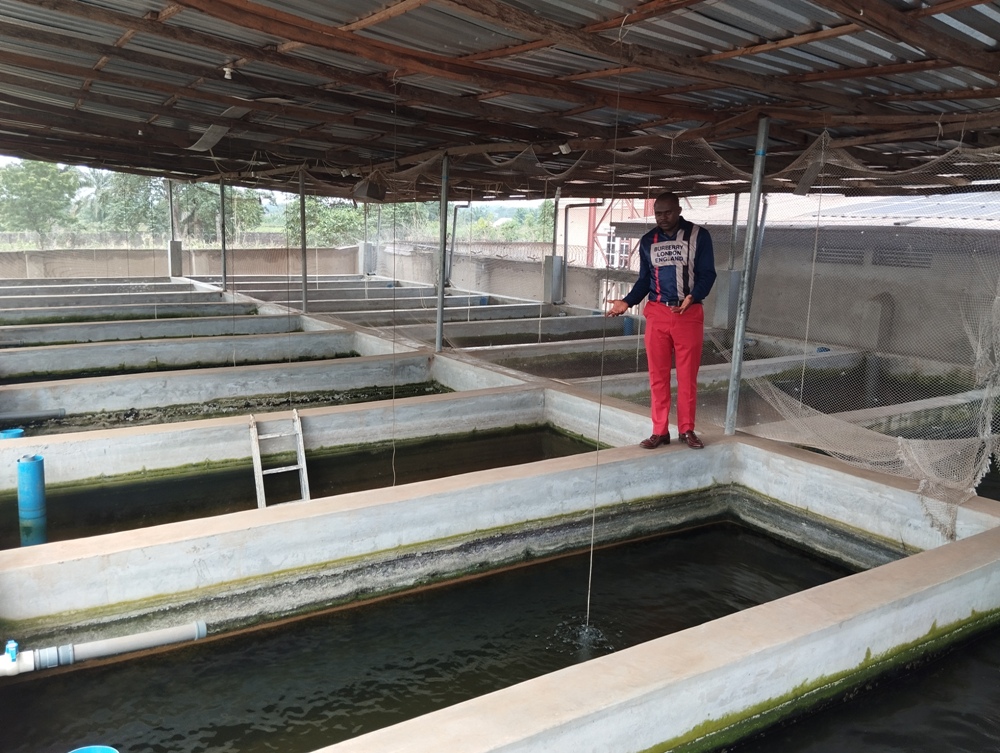
The CEO of Street Farm and Aquaculture Management Enterprise, Isuaniocha in Awka North Local Government Area, Mr Donald Umejiaku, said that he uses Taenprowiz in his fish farm which has 20 ponds with over 15,000 fish.
“One of the major things Taenprowiz will help you in is to make sure that there will be no financial strain to your pocket before you start making money”, he pointed out.
“Taenprowiz will introduce you to monthly input and monthly output. It will make you not to commit so much money at once. It helps to reduce financial strain on the part of the entrepreneur.
“Again, it gives an opportunity for evaluation. For example, when we started newly, we were doing grading. But we discovered that it was usually not accurate. Sometimes you will see 500, 400, 300 grams.
“Fish grow in batches. If you have 1000g and 700g in one pond, the bigger one may swallow the smaller one. And that would be a loss for your business. But Taenprowiz helps you to do proper grading of the fish.
“What Taenprowiz has done for me is that it structured my business such that I always have fish. My customers know that I always have fish. It helps me to maintain the pace.
“Taenprowiz helps you to know the quantity of feed you have served the fish at every point in time.
“So, at every point in time, you will always know the quantity you have served each pond within a specified period of time,” Umejiaku explained.
Another fish producer, Mr Primus Odili, described Taenprowiz as “a masterpiece in a business enterprise” which has helped to improve his fish productivity.
Odili, who is the CEO of Chinyelu Agro Mechanised Farm, Aguleri in Anambra East LGA, said: “Prior to Taenprowiz, we had tried so many things mechanically to keep track of records because everything about fish farming and everything about farming actually is record keeping.
“Taenprowiz has been able to bring to bear all the grey areas that one will have to worry about in fish farming and with the manner of record keeping that Taenprowiz guarantees, one doesn’t have to worry about those grey areas anymore.
“This is because with Taenprowiz, you know exactly the number of fish that you have; the quantity of feed that they need to eat every day; their weight; their sizes and all that”, Odili stated.
Head of the Fish Unit at the farm, Afoma Odili, said that Taenprowiz has helped the establishment stop stealing by dishonest members of staff of the agro company.
“The company was running before we started making use of Taenprowiz and when the Taenprowiz system was introduced, we noticed a lot of changes,” Afoma stated.