
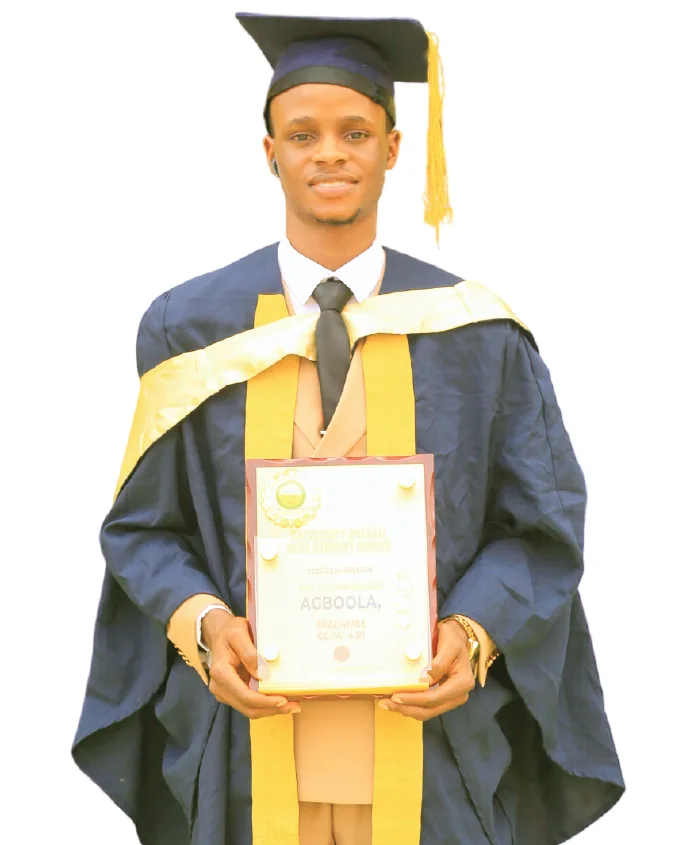
Pius Agboola, who emerged as the overall best graduating student of Osun State University for the 2025/2026 academic session with a 4.91 CGPA in Mechanical Engineering, speaks with AYOOLA OLASUPO about his achievement, the role of academic mentors in his success and his plans for further studies
What inspired you to study mechanical engineering?
I was born and raised in Lagos State, and I was the third of four children. I had both my primary and secondary education there. My childhood was quite straightforward, and my upbringing was not particularly complicated. Things were smooth and my parents were very supportive from the beginning.
I didn’t have any particular passion while growing up. However, I wanted to study aeronautical science or aeronautical engineering. That was my ambition. Along the way, about five years ago, I almost ran out of options, so I decided to look for the best alternative, which was mechanical engineering. It is a very flexible field, and you can easily move from one area to another. That was how I settled for the course.
Can you take us through your first experience as an undergraduate?
More Read

I was a direct-entry student. I gained admission through an A-level programme, particularly the Joint Universities Preliminary Examinations Board. So, my first year was spent on the JUPEB programme. In my second year, I moved to the Faculty of Engineering.
It was like entering a completely new world because of the differences between the various levels of education. Moving from secondary school to JUPEB was one thing, but moving from JUPEB to a tertiary institution was entirely different. JUPEB was more like a secondary school setting, but a tertiary institution operates differently. The way things were done, how classes were handled and the arrangements were quite different. It was another world entirely.
When did you realise that you could graduate at the top of your class?
It was in my 200 level because the potential was already there. Initially, I never thought I would graduate as the overall best graduating student. That was not part of my plan from the beginning. I just wanted to get good grades because I believe in having a solid foundation. A foundation matters a lot, especially in an academic journey.
My aim from my 200 level was to build a very good foundation and then build on what I had learnt along the way. Fortunately, I started well and maintained that performance.
You mentioned having a good academic foundation. What study habits helped you maintain such academic performance?
First, I believe there is nothing new under the sun. The challenges I may face are things other people have faced in the past. So, the first thing I do is reach out to my seniors. I had about four academic mentors who guided me in my studies, and they all graduated with first-class degrees.
As a matter of fact, the overall best graduating student of the previous session, Sonia Adetu, was one of my greatest mentors in mechanical engineering. So, I basically reached out to them and asked what I needed to know about particular courses. They guided and told me about some lecturers and what they expected from students.
For instance, some lecturers expect you to explain your points extensively, while others want you to highlight the main points and go straight to the answer. Knowing your lecturers is one of the important strategies.
As for reading, I cannot prescribe one particular method because everyone has to discover what works best for them. Personally, I can stay with my books for up to six hours straight without standing up. That is just how I am. If I recommend that method to someone who cannot read for two hours straight, it could become a problem. So, I believe everyone should find the reading method that works best for them.
Reading is not necessarily complicated. Most people spend time reading things that do not matter. You might spend hours studying materials that will not come up in a test or examination. Reading the right materials is also important. Having seniors who can guide you helps you avoid wasting time on irrelevant materials and focus on important topics. Getting the right materials from lecturers and having the necessary resources at your disposal also matter a lot.
Some students read at night, attend night classes and participate in group discussions. Which of these methods did you use?
Personally, I never attended a night class throughout my five years at the university. That includes my one year on the A-level programme and four years studying mechanical engineering. I never attended night classes because I do not like them.
Secondly, I like reading alone in my private space, where nobody can disturb me. Even when people see me, I am usually just working things out with my calculator. When it comes to calculations, understanding certain concepts and internalising new information, I prefer to study alone because I value my privacy.
However, I have brilliant and intelligent friends. Whenever we need to discuss a particular topic or solve a difficult question, I join them, and we work on it together. But that does not happen all the time. It is only occasionally, when the need arises.
Did you participate in any extracurricular activities?
In my 300 level, I served as one of the tutors. I taught engineering mathematics, particularly to junior students. I also taught some courses to my coursemates in other departments, such as agricultural engineering. These included related courses such as mechanics of machines.
In my fourth year, I began taking on leadership responsibilities, following the example of my mentors, who were academic directors at the faculty and departmental levels. In my final year, I served as the academic director of the Faculty of Engineering. So, my journey was basically from being a tutor to becoming an academic director.
How were you able to balance your academics with the responsibilities of tutoring other students?
I believe there is a time for everything. Whenever I took up tutoring responsibilities, particularly in my third and fourth years, I usually scheduled them for weekends. Mondays to Fridays were reserved for my own studies. I could not share that time with anybody. If I had to give up any of that time for a tutorial, it meant I had already made enough time for my own work.
In my 500 level, I had to delegate responsibilities. I found capable people in the 300 and 400 levels who could handle some of the courses. There were courses I did not particularly like, such as mathematics, engineering mechanics, chemistry and physics. So, I had to delegate some responsibilities because I already had a lot on my plate in my 500 level.
Tell us about some difficult periods you experienced as a student.
I would not say I faced any major challenges. Whenever something appeared to be a mountain or a difficult problem, I reached out to my seniors, and they gave me hints. After getting their advice, I would pray and try to find my way through it.
Challenges are relative, and I do not believe there is any challenge that is entirely new or impossible to overcome. Of course, people face difficulties in different areas, including financial challenges, but I would not say these were major obstacles for me.
Was there a time your academic performance did not meet your expectations?
Yes, I think that happened twice: in the second semester of my 300 level and in my 500 level. The second semester of my 300 level was when I experienced my first real academic setback. I got a C in one of the mechanical engineering courses, and that affected my CGPA.
However, I could not allow that to discourage me. Also, in my final semester, I got a B in one course. Honestly, I expected to get an A in that course.
How did you manage the disappointment?
Different people process things differently. Personally, I am the kind of person who withdraws and spends time alone. I also talk to people I trust, including my mother and my best friend. Once you talk to people who understand you, you can work through things faster. That is my personal coping mechanism, and it has been very effective for me.
Sometimes, I shut out everything and turn off my phone for one or two hours just to be alone and process things. Once I have done that, I can move on. No matter what happens, I try not to let it weigh me down.
How did you feel when you eventually emerged as the overall best graduating student?
What went through my mind was that it was a bonus dream come true. As I said earlier, becoming the overall best graduating student was not part of my original plan. When I got to my 500 level and saw my CGPA, I thought, “Well, who knows? I might be able to achieve this.”
To the glory of God, it happened, so when I heard the news, I was happy. I can say it was a testament to the value of education because I had simply been doing my thing from the beginning.
I did not have the mindset of competing with others. I did not believe that because I was doing well, others should not do well, or vice versa. I have always believed that it is me versus me. The sky is big enough for everybody to fly. The fact that I am doing well does not mean someone else cannot do well, too.
That has always been my belief, and it guided me throughout my studies. It was wonderful to realise that I could actually achieve that level of success. To the glory of God, it happened.
What does the achievement mean to you and your family?
I think my family is happier than I am. I am happy, too, but I have seen their tears of joy. It was evident that they were genuinely happy for me and for the family as a whole.
I am the first person in my nuclear family to graduate with a first-class degree. My older siblings also graduated with good results, but none of them graduated with a first-class degree. This is a source of great joy for me.
My current plan is to further my education. If I can secure admission to a programme abroad, that would be great. I want to specialise in thermofluids and energy systems.
It is a major subfield of mechanical engineering that focuses on fluid mechanics, heat transfer and energy conversion. It applies directly to pipeline transport, pumps, compressors, turbines and heat exchangers, which are essential to oil and gas operations. That is the area in which I plan to specialise.
Why are you interested in that particular field?
I believe that, in the end, most things boil down to money, even when we talk about passion. I am not against people having passion. Personally, I do not have a strong passion for many things. However, I believe that if your passion cannot provide what you need, it may take you a long time to achieve certain things. After getting what you need, you can then return to your passion and explore it.
(Punch)