

By Obinna Odogwu
Nestlé, a multinational food and beverage company, in 2013, launched an ambitious youth programme – Nestlé Needs YOUth – with the aim of helping 10 million young people around the world access economic opportunities by 2030.
The initiative focuses on three areas: employment and employability, entrepreneurship, and agripreneurship; with the idea being to help young people gain access to apprenticeships, traineeships and job opportunities, thereby empowering them with the skills they need to thrive.
A breakdown of the programme shows that under employment and employability, the company planned from onset to help young people secure fulfilling jobs and careers by facilitating access to apprenticeships, traineeships, internships, and job opportunities around the world.
Under entrepreneurship, the company empowers young innovators to learn new skills, test ideas or grow their own businesses. The support includes business mentorship with senior executives from Nestlé, and facilitation of access to Nestlé R&D and innovation experts across the world.

Under agripreneurship, Nestlé inspires “farmers of tomorrow” by making farming look more attractive to young people.
The company encourages them to run their farms as business and to embed regenerative agriculture methods in support of a just transition to regenerative food systems.
Nestlé’s 2025 Non-Financial Statement shows that it actualised that ambitious target in 2024, six years earlier than planned.
In the Social Disclosures section of the document, specifically on page 124, Nestlé says that it surpassed the target of 10 million with extra 200,000 young people supported with access to economic opportunities even before the 2030 deadline it set for itself.
“In 2025, we continued supporting young people, with an additional 2.6 million people supported”, the company’s Non-Financial Statement reads.
Nestlé says that it believes that by giving young people the skills, knowledge and opportunities they need to succeed, they can improve their personal economic circumstances, and contribute to the social development in their communities.
“In addition, our support for the young Nestlé farmers of today and tomorrow through the initiative means we can help future generations embrace and embed regenerative agriculture practices”, it adds.
Nestlé’s progress report shows that it supported 12.8 million young people across the world to develop future-ready skills from 2017 – 2025 cumulatively.
Nestlé Nigeria’s contributions
In Nigeria, Nestlé is creating opportunities for young people in the country through various initiatives.
In June 2025, the company trained a total of 300 ‘My Own Business’ (MYOWBU) operators in Lagos through its Nestlé Professional.
MYOWBU is designed to empower young people across Central and West Africa by helping them establish sustainable careers in street vending.

More than a vending initiative providing affordable beverage solutions such as NESCAFÉ and MILO enjoyed by millions of Nigerians every day, it is a sustainable means of livelihood for many young people seeking dignified work, financial independence, and a chance to build a better future.
The Business Manager for Nestlé Professional, Mrs. Funmi Osineye, at the event, said that at the heart of the MYOWBU initiative was a belief in the power of entrepreneurship to transform lives.
She explained that the workshop was not just about technical skills, but about building confidence, nurturing ambition, and strengthening the community of young business leaders who represent Nestlé brands with pride and purpose.
With the goal of advancing operational excellence and sustainable growth, the workshop delivered focused training in business management, hygiene, food safety, waste management, and customer service.
One of the MYOWBU operators, Michael Adeosun, who was said to have spent about 20 years in the business, said that the ‘My Own Business’ initiative had touched his life positively.
Adeosun, recognized as the longest-serving MYOWBU operator, said: “MYOWBU transformed my life. I was able to leave the streets, build a home, and provide for my family. This journey has taught me that consistency and hard work pay off.”
A former MYOWBU operator, now a Nestlé distributor, Joseph Abraham, briefly narrated how he started with the company.
“I started as a pushcart operator”, he recalled. “Today, I’m running my own Nestlé distribution business. Thanks to the foundation Nestlé helped me build. Dreams do come true.”
The above stories and others shared during the event were testaments to the programme’s real-life impact.
The Good food, Good life company said that the MYOWBU initiative has so far created over 1,500 employment opportunities across Nigeria, equipping the youth with fully branded pushcarts, shoulder kits, and essential start-up resources from Nestlé Professional.
It said that the programme which began with a few young people has evolved into a powerful model for sustainable entrepreneurship, and shared value creation.
Establishment of Nestlé Technical Training Centre (TTC)
In 2011, Nestlé established a technical training centre (TTC) where young people are trained and equipped for future leadership in the business world.
TTC is a multi-skill engineering programme which offers a rigorous 18-month curriculum designed to combine theoretical learning with hands-on engineering experience. It provides training on essential skills in Mechanical, Electrical, and Automation Engineering.

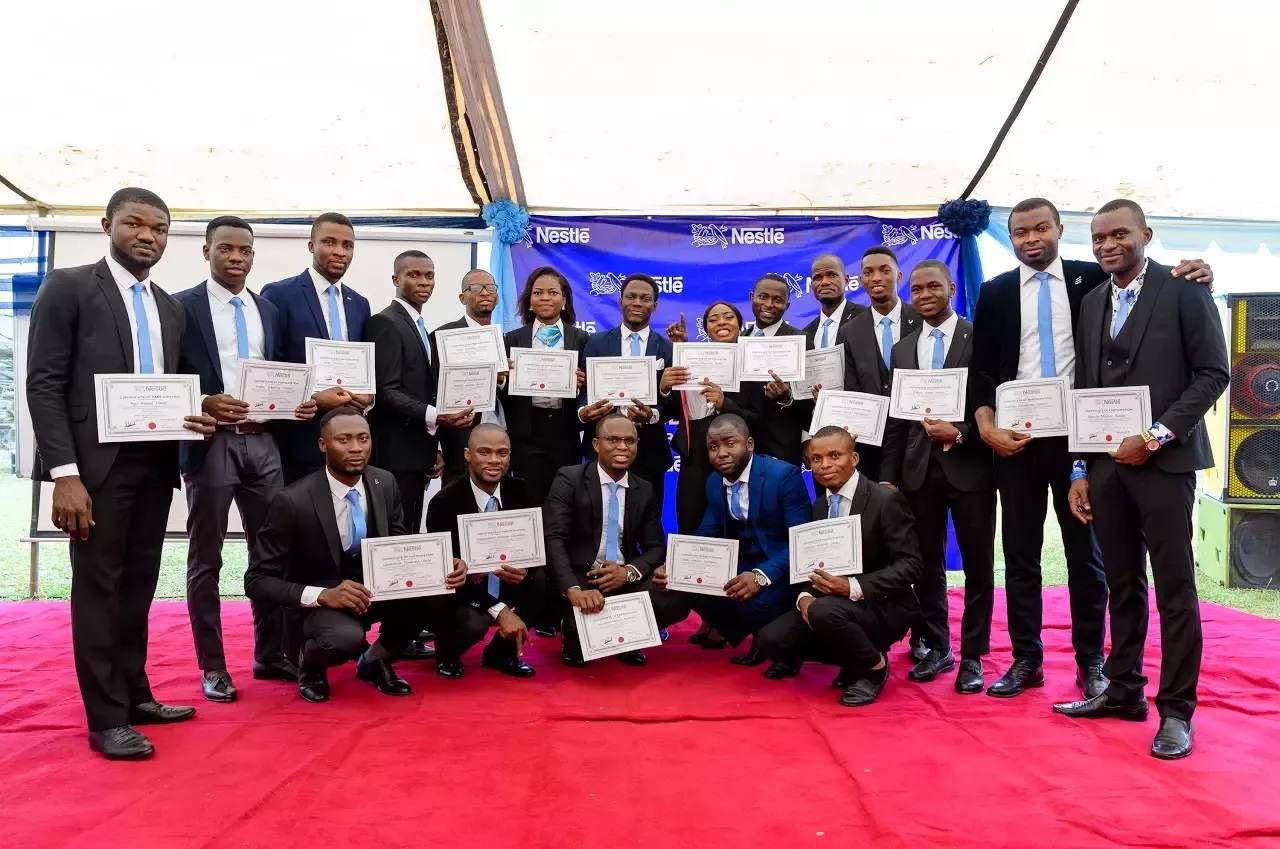
The training programme culminates in participants receiving the highly regarded City and Guilds of London Technicians’ Certification, a qualification that significantly enhances their employability in Nigeria’s evolving industrial landscape.
It was gathered that the content of the course is based on the syllabus of the City and Guilds of London technicians’ examinations certificates in engineering, one of the leading vocational education organisations in the world.
The successful trainees also receive certifications in level 3, 4 and 5 of City and Guilds of London upon completion of their training programme.
In addition to that, the top five students are given the opportunity to conclude their training with an eight-week apprenticeship at two of Nestlé’s technical sites in Switzerland (Orbe and Broc).
It was gathered that upon completion of their training, each graduating batch are given the opportunity to join Nestlé in Nigeria.

This TTC programme started at the company’s Agbara factory in 2011 and in 2017, the company set up the second centre in its Abaji factory to reach those closest to the company’s operations.
Its successes in Agbara and Abaji inspired the company to establish the TTC model in its Flowergate factory in Sagamu, Ogun State in February 2023.
Available report shows that about 230 trainee graduates have benefited from the technical training programme which started about 15 years ago, with 98 per cent of them securing employment at Nestlé Nigeria.
The Agbara training centre is run in collaboration with the Swiss State Secretariat of Migration (SEM).
Nestlé Nigeria’s investment in youth development has been substantial, costing valuable time and resources. The company disclosed that it had committed over N6 billion so far to ensure the success of the training initiative.
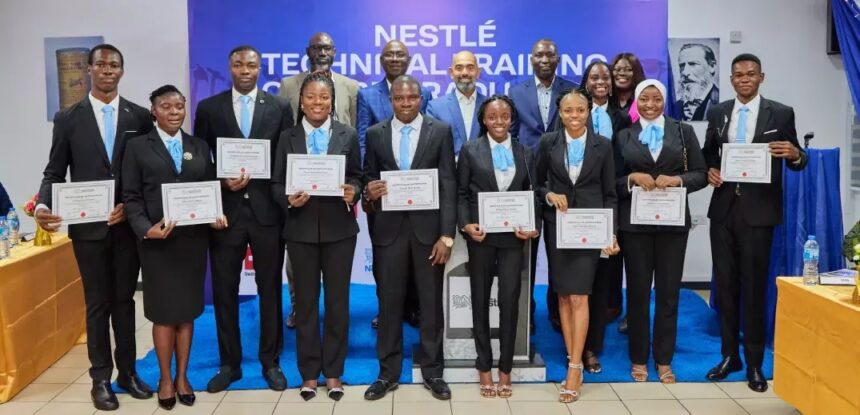
The Managing Director/CEO of Nestlé Nigeria, Mr. Wassim Elhusseini, while speaking at a graduation ceremony at Flowergate, reiterated the company’s long-standing commitment to nurturing talents in the country.
“For us, this programme is about more than just imparting technical skills, it’s about empowering young people to shape their futures and become agents of change in their communities”, Elhusseini stated.
He argued that by equipping the youth with technical expertise, Nestlé has succeeded in not just opening doors to them for personal and financial growth, but also making a long-term investment in Nigeria’s future.
Speaking on the technical training programme, Nestlé Executive Vice President and Chief Executive Officer for Zone Asia, Oceania, and Africa, Remy Ejel, described it as important, saying that it not only helps meet the demand for skilled labour in Nigeria but also supports the local economy and aligns with Nestlé’s broader objectives of enhancing youth employability.
“It is crucial to help the younger generations reach their full potential and support economic growth by offering opportunities for skill development and employment”, Ejel added.
On his part, Chargé D’Affaires of Nigeria to Switzerland and Liechtenstein, Osuobeni Rawlings Krobari, said that he was delighted to see the programme’s success in enhancing the employability of young people in Nigeria.
“A skilled workforce is vital for our long-term growth. I extend my heartfelt congratulations to the graduates on their achievements. I encourage them to view their new skills as not only a foundation for their careers but also an opportunity to be ambassadors for their generation, by sharing knowledge and best practices with their peers”, he said.
Ms. Valérie Gass, Policy Advisor, State Secretariat for Migration (SEM), said: “This programme was launched the same year as the migration partnership between Switzerland and Nigeria, which aims, among other things, to create greater economic opportunities locally.
“The programme is an excellent example of a successful Swiss public-private partnership that effectively addresses challenges and creates meaningful opportunities. We take great pride in this initiative and remain committed to supporting youth in Nigeria.”
Nestlé and SEM jointly invest in the programme, reflecting their commitment to provide more economic opportunities to young people.
Testimonials from the TTC beneficiaries
Some of the TTC participants have commended Nestlé Nigeria for the opportunity given to them to develop their technical skills.
One of them, Dolapo Adedoyin Okunola, 25, while expressing her gratitude to the Good food, Good life company, described the training course as a rare opportunity.
Okunola, a programme graduate aspiring to become a Technical Manager, said that the highlight of her experience was participating in impactful projects aimed at improving energy efficiency and machine validations, while collaborating with a diverse and talented team.
She also enjoyed the opportunity to learn basic French and explore the picturesque Swiss landscapes.
“The Nestlé technical training programme has significantly enhanced my abilities and expanded not just my skills and academic knowledge but also my experiences of different cultures and languages”, Okunola stated.
“The comprehensive training I received in Nigeria, combined with my internship in Switzerland provides me a competitive edge in the corporate world. I am confident that this programme has laid a strong foundation for my career.”
The programme not only enhances the technical skills of talented young Nigerians but also fosters cultural understanding and knowledge sharing between Switzerland and Nigeria.
On his part, Ezekiel Bibire, described the 18 months training exercise as enriching.
“The journey was not easy, but through it all, we have achieved this milestone and are delighted for the knowledge imparted,” he stated.
Another beneficiary, Moshood Kilaso, stated that he was satisfied with the training programme, saying that it was rich in content. He encouraged his colleagues to maintain resilience in their duties and strive to be the best.
Nestlé Nigeria’s community scholarship programme
Nestlé also invests in the future of young people through scholarship programmes aimed at high-achieving senior secondary and tertiary students pursuing studies in science and technology.
The scholarship supports students in Nestlé’s host communities. And since launching the community scholarship in 2020, Nestlé Nigeria has remained committed to providing financial support to students in its host communities.

This support covers tuition, accommodation, uniforms, books, and other essential expenses, ensuring these students have the resources they need throughout their education journey.
The scholarship scheme was launched in Abeokuta, Ogun State in November 2020 with 49 students from communities around the company’s Flowergate factory by Sagamu Interchange and Abaji factory. And since 2020, Nestlé has been offering scholarship awards to deserving beneficiaries.
Victoria Uwadoka, Nestlé Nigeria Corporate Communications, Public Affairs, and Sustainability Lead, emphasized the company’s commitment to creating shared value, linking the company’s success to the well-being of its host communities.
She encouraged the scholarship recipients to strive for academic excellence to stay competitive on a global scale.
“These scholarships reflect our unwavering dedication to investing in the future of our youth. At a time when economic challenges place added strain on families nationwide, we’re proud to provide meaningful financial support that eases this burden.
“By investing in education, we’re not only empowering individual students but also fostering the growth and prosperity of our entire community”, Uwadoka said.
One of the recipients, Adeyemi Gbenga Daniel, who’s studying Mechanical Engineering at University of Lagos, said: “This scholarship empowers us to pursue our dreams, fuels our passion for learning, and helps us explore opportunities that might have otherwise been out of reach.”

Traditional leaders of the communities where the recipients hail from expressed gratitude to Nestlé for adding value to the lives of their children, and their communities by extension.
The Ona of Abaji, the Alagbara of Agbara, and the Akarigbo of Remo Land, represented by their chiefs, praised Nestlé Nigeria for keeping its promises and making a real difference through its Creating Shared Value (CSV) initiatives.
They recognized the positive effects on their communities, from educational support to youth empowerment, and promised their ongoing support for Nestlé’s operations, ensuring that the communities remain welcoming for business growth.
As the programme continues to evolve, Nestlé remains focused on nurturing talent and encouraging academic excellence. And by investing in the education of young people, the company seeks to create long-lasting positive impacts in its host communities, helping to shape a more promising future for Nigeria’s next generation of leaders and innovators.